
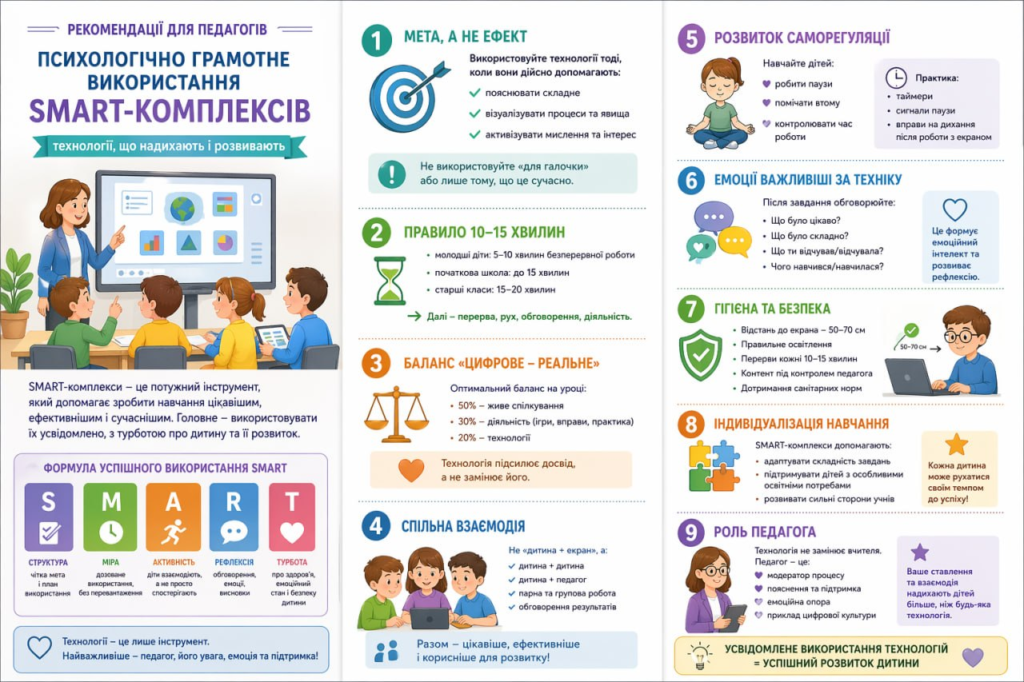
SMART complexes truly make learning more engaging and modern—but only when used mindfully. Technology in itself is not the ultimate goal. It should explain complex concepts, visualize processes, and stimulate thinking, rather than just being present in the classroom because it is expected.
One of the basic guidelines is the duration of continuous screen time:
- Younger children: 5–10 minutes
- Primary school: up to 15 minutes
- High school: 15–20 minutes
After this, there must be a break, physical movement, discussion, or practical activity. This is not a technical requirement, but a matter of the child’s physical and psychological health.
The optimal lesson structure when integrating technology looks like this:
- Half of the time – live communication
- A third of the time – activity (games, exercises, practice)
- Only a fifth of the time – direct technology use
A digital tool enhances the experience, but it does not replace it.
The quality of interaction is also crucial. It shouldn’t be “child + screen,” but rather child-to-child and child-to-educator interaction, including pair and group work. After an assignment, it is valuable to discuss what was interesting, what was challenging, and what emotions arose. This develops reflection and emotional intelligence—something no technology can achieve instead of a live conversation.
Furthermore, SMART complexes help adapt the difficulty of tasks to a specific student, support children with special educational needs, and develop everyone’s individual strengths. Every child can move at their own pace, which is one of the most valuable opportunities modern tools provide.
Ultimately, technology does not replace the teacher. The educator remains the moderator of the process, an emotional anchor, and a role model for digital culture. An adult’s attitude and attention inspire a child far more than any screen ever could.